Flying Parents and Seniors Between India and the USA: Wheelchair Assistance by Airline, Special Meals, Oxygen Rules and Visitor Medical Insurance (2026)
How to request wheelchair assistance on Air India, United, American, Emirates, Qatar, Etihad, Lufthansa, BA and Turkish (48 hours, free by law), the WCHR/WCHS/WCHC codes, Hindu and Jain meal codes, oxygen and MEDIF rules, paid meet-and-assist at Delhi and Mumbai, and what visitor medical insurance for parents costs.
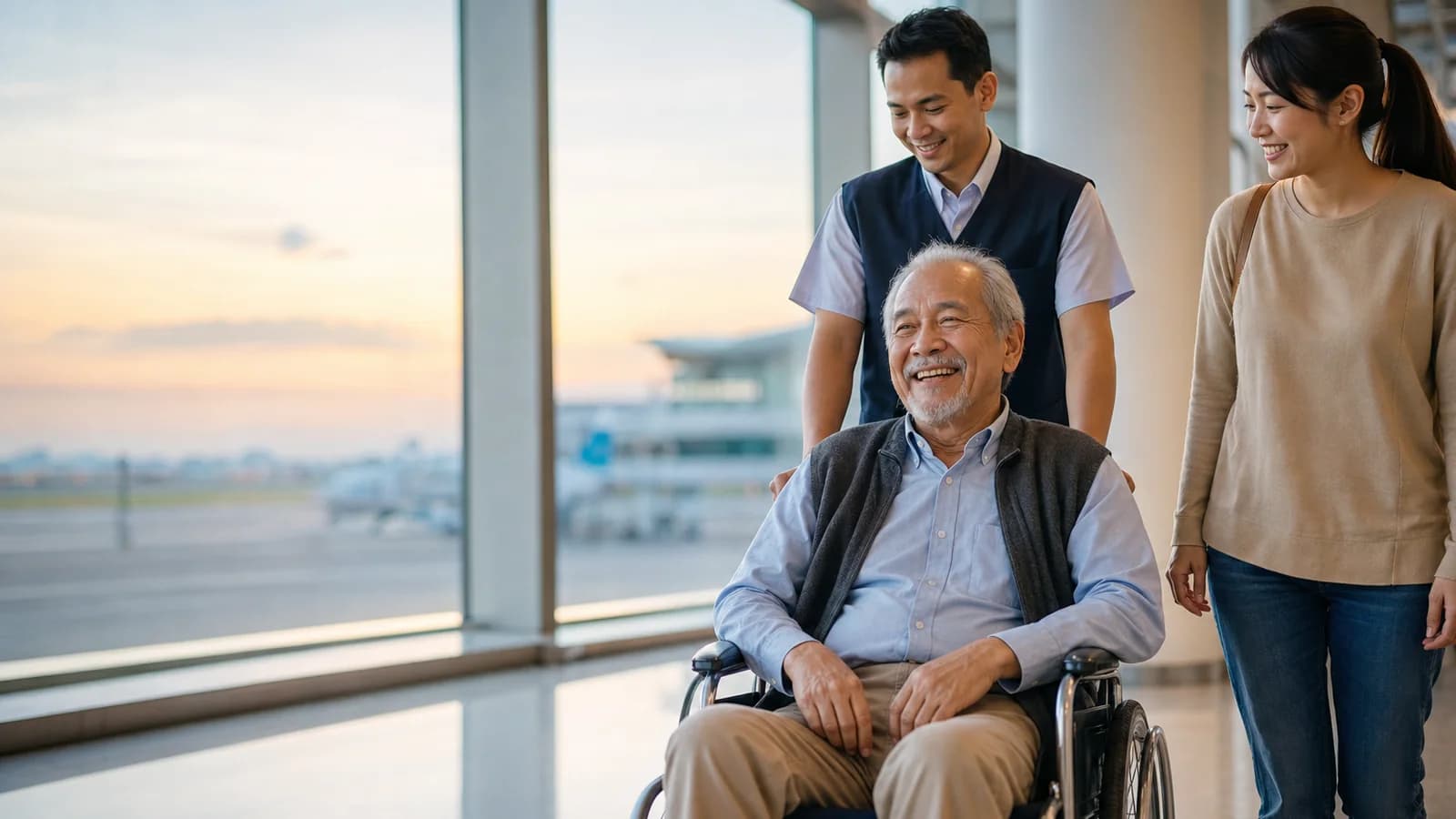
Photo: Illustration for Voldeluxe Travels
Quick answer: Wheelchair assistance between India and the USA is free on every airline and is a legal right under US rules (14 CFR Part 382) and India's DGCA regulations. Request it at least 48 hours before departure, through the airline's website or by phone, and name the level you need: WCHR (can walk, needs help with distances), WCHS (cannot manage steps) or WCHC (needs a wheelchair to the seat). Ask separately for the meal code (AVML for Hindu vegetarian, VJML for Jain, DBML for diabetic). Medical oxygen and some medical conditions need a doctor's form (MEDIF) sent to the airline 48 to 72 hours ahead. And buy visitor medical insurance before a parent lands in the USA: a single hospital day costs about $3,300.
Key Takeaways
- Every airline on this corridor gives wheelchair assistance at no charge; US law forbids charging for it (14 CFR 382.31) and India's DGCA requires it "without any additional expenses". Give 48 hours' notice; Air India calls it mandatory for WCHC, and Lufthansa says later requests cannot be guaranteed.
- The three wheelchair codes matter. WCHR for a parent who can walk to the seat, WCHS if steps are the problem, WCHC if they cannot walk at all. Ask for the right one, because it decides whether an ambulift or an aisle chair is waiting.
- No airline has an "unaccompanied senior" service. A parent who can manage the flight travels alone with assistance at every airport; a parent who cannot assist in their own evacuation may be required to travel with a companion (14 CFR 382.29).
- HNML is the Hindu non-vegetarian meal. Order AVML for a vegetarian Indian meal, VJML for Jain, DBML for diabetic, at least 24 hours out.
- Visitor medical insurance is not required for a US visa but is essential: emergency rooms must treat anyone, and the bill follows the patient. Budget roughly $1,100 to $1,200 for a 70-year-old on a 90-day, $100,000 comprehensive plan (Forbes Advisor).
Our desk books the same journey several times a week: a parent in their seventies flying from Delhi, Mumbai, Hyderabad or Ahmedabad to a son or daughter in the USA, usually alone, often for the first time in years. The flights themselves are the easy part. What decides whether the trip goes well is a set of requests that have to be made in advance, each with its own code, deadline and rule. This guide sets them out airline by airline, with the regulations behind them, and then covers the two things families most often leave until the last week: medical insurance and medicines.
Which Wheelchair to Ask For
Airlines worldwide use three codes, and the one you give decides what equipment is positioned.
| Code | Means | Ask for it when |
|---|---|---|
| WCHR (ramp) | Can walk short distances and climb steps; needs a wheelchair for the long walks in the terminal | A parent who is slow or tires easily but manages stairs |
| WCHS (steps) | Can walk to the seat but cannot climb steps; needs an aerobridge or an ambulift | Knee, hip or heart conditions; anyone who cannot do a flight of stairs |
| WCHC (cabin) | Cannot walk; needs a wheelchair to the seat and an aisle chair to transfer | Anyone who is not mobile at all |
WCHS matters more in India than in the USA: at many Indian airports a flight can board by bus and stairs, and Indian regulations require the airport to provide an ambulift (a lift truck) for a passenger who cannot climb them. Air India says 48 hours' notice is mandatory for WCHC so that the aisle chair and lift are arranged (Air India wheelchair requirements).
How to Request Assistance, Airline by Airline
All of these are free. Request at booking if you can, otherwise through the airline's "manage booking" page or by phone, and confirm again 48 hours before each flight.
| Airline | How and how early | Medical clearance and oxygen |
|---|---|---|
| Air India | Online or through the call centre, at least 48 hours ahead; medical cases go through a MEDIF form to the nearest office, and the airline's medical officer asks for 72 hours | Wheelchair alone needs no form; a medical condition does (disability assistance, medical clearance) |
| United | Accessibility Desk at 1-800-228-2744 or the online form; seating and aisle-chair requests at least a week ahead; wheelchair filter in the app | FAA-approved portable oxygen concentrators (POC) carried free; 48 hours' notice and a medical certificate may be required (United accessibility) |
| American | Tick "special assistance" when booking on aa.com, or call the Special Assistance Coordinators at 1-800-433-7300; 48 hours for POCs and battery devices | FAA-approved POCs only; no airline-supplied oxygen (mobility and medical devices) |
| Emirates | At booking or by phone at least 48 hours ahead; wheelchair desks in Dubai Terminal 3 | MEDIF (part 2 completed by a physician) at least 48 hours ahead for medical conditions; not needed for a wheelchair alone or an approved POC (Emirates accessibility hub) |
| Qatar Airways | Manage Booking up to 48 hours before; arrive three hours early; paid Al Maha meet-and-assist in Doha | MEDIF between 48 hours and 7 days before each flight; Qatar can supply oxygen on board with a MEDIF (disability and medical) |
| Etihad | At least 48 hours ahead via etihad.com/manage or +971 600 555666 | Medical report in English no more than 14 days old; some regional pages ask for 72 hours for a MEDIF (medical assistance) |
| Lufthansa | Online registration at least 48 hours ahead; later requests "cannot be guaranteed" | Own oxygen, airline oxygen (chargeable) and POCs each have a code; MEDIF to the Medical Operation Center (special needs) |
| British Airways | Manage My Booking at least 48 hours ahead; "Service 1" to the aircraft door, "Service 2" including stairs | MEDIF reviewed by BA Health Services for oxygen, stretchers and equipment (how to request assistance) |
| Turkish Airlines | At least 48 hours ahead; later requests subject to availability | No personal oxygen tanks; the airline supplies oxygen against a medical report no more than 10 days old stating no objection to flying (special assistance) |
| Air France and KLM | Air France Saphir service; KLM CARES at klmcares@klm.com; wheelchair users collect boarding passes at the counter | Air France requires clearance above roughly 2 litres per minute of oxygen; KLM advises at least 2.5 hours for a connection at Amsterdam with assistance (KLM mobility assistance) |
Two habits save most of the trouble we see. Put the request in the booking itself, so it appears on every flight and every airline on the ticket, and reconfirm by phone two days out, because a request made months earlier can fall off a rebooked itinerary.
What the Law Guarantees
In the USA and on every flight to or from it, the Air Carrier Access Act rules apply to US and foreign airlines alike. The airline must provide wheelchair or guided assistance to board, deplane and connect, and it "must not impose charges for providing facilities, equipment, or services that this rule requires" (14 CFR 382.31). For a portable oxygen concentrator the airline may ask for 48 hours' notice, a medical certificate dated within 10 days of the first flight, and batteries for 150 percent of the flight time (US DOT guidance). A new DOT rule in force since January 2025 treats a mishandled wheelchair as an automatic violation and defines "safe and dignified" assistance; several of its provisions are under court challenge and DOT has deferred enforcing four of them until April 2027, but the right to free assistance is not among them (Federal Register, December 17, 2024).
In India, the DGCA's Civil Aviation Requirement on carriage of persons with disability or reduced mobility requires 48 hours' notice, assistance from the terminal to the aircraft "without any additional expenses", free carriage of assistive devices, and an ambulift at the airport where there is no aerobridge. Since 2022 an airline cannot refuse a passenger on disability grounds without written reasons (DGCA CAR Section 3, Series M, Part I). An amendment of October 31, 2025 lets airlines charge an assistance fee to passengers who are not disabled or of reduced mobility and ask for a wheelchair anyway, with the fee shown on the airline's website; a genuinely elderly or less-mobile parent stays free (The Week, October 31, 2025). Expect to be asked, politely, whether the wheelchair is needed.
Meet-and-Assist at Indian Airports: Free and Paid
The airline's wheelchair is free and covers check-in, security, immigration and boarding. What it does not cover is someone to stand in the queues with a parent, carry the bags, or sit with them for three hours. That is the paid "meet-and-assist" market.
- Delhi: Air India opened dedicated Family Assistance check-in counters at Terminal 3 in May 2025 for passengers with wheelchairs and elderly travellers, free of charge (Air India newsroom). Air India's paid Namaskar Sewa meet-and-assist runs at Delhi and Mumbai for travellers flying alone; the fee is quoted at booking. The airport operator publishes no tariff of its own, and third-party concierge services sell similar escorts.
- Mumbai: wheelchairs are booked through the airline; wheelchair desks sit at Terminal 2 Gate 1 and Terminal 1 Gate 2, a stretcher ambulance to the aircraft is free with 48 hours' notice, and the airport's paid Pranaam meet-and-greet is booked through the operator (CSMIA special assistance, Pranaam).
- Hyderabad: the airport sells an official meet-and-greet service in tiers; the current international tariff is on the airport's own page (Hyderabad airport meet and greet).
Our rule of thumb: a parent who is mobile but anxious about the airport benefits most from meet-and-assist on the Indian side, where the queues are longest; on the US side the airline wheelchair and a family member at arrivals are usually enough.
Travelling Alone: What Airlines Can and Cannot Do
No airline on this corridor sells an "unaccompanied senior" product the way they sell one for children. Air India states plainly that it cannot supervise a passenger who is unable to travel alone. The line that matters is physical: under US rules an airline may require a safety assistant only if the passenger could not physically help in their own emergency evacuation, and if the airline insists on one, that companion flies free (14 CFR 382.29). India's regulation forbids airlines from demanding a medical certificate from someone travelling without an escort who only needs help at the airport or in flight.
In practice a parent who can walk a few steps, use the lavatory and follow instructions travels alone comfortably with WCHR or WCHS assistance at every airport. For one who cannot, the choice is a companion or, on a one-stop itinerary, a routing where the connection is short and assisted, which is where the airline you choose matters.
Special Meals: The Codes That Matter
Special meals must be ordered in advance, usually at least 24 hours before the flight (American accepts them from 30 days to 24 hours out). The codes are standard across airlines (IATA SSR codes):
- AVML: Asian vegetarian, the Indian vegetarian meal with no meat, fish or egg.
- HNML: the Hindu non-vegetarian meal. The most common mistake we see is a vegetarian parent booked with HNML because it says "Hindu".
- VJML: Jain meal, no animal products and no root vegetables, as Air India describes it (Air India special menu).
- DBML: diabetic.
If a meal was not loaded, cabin crew will usually find a vegetarian alternative, but on a 15-hour flight it is worth packing a few familiar snacks regardless.
Oxygen, CPAP and Medical Clearance
- A portable oxygen concentrator approved by the FAA can be used on US airlines and on foreign airlines flying to the USA; give 48 hours' notice, carry a doctor's letter and enough batteries for one and a half times the flight time.
- Airline-supplied oxygen is available on Qatar Airways and Lufthansa (chargeable) and on Turkish Airlines with a recent medical report, and not at all on American. It must be arranged through a MEDIF several days ahead, so start early.
- A CPAP machine for sleep apnoea travels as medical equipment and does not count against the cabin bag allowance on most airlines; carry it in the cabin, with a spare power adapter.
- A MEDIF (medical information form) is the airline's standard questionnaire completed by the passenger's doctor. It is required for a recent surgery, an unstable condition, oxygen or a stretcher, not for a wheelchair alone. Etihad asks for a report no more than 14 days old, Turkish no more than 10.
Layovers and Routing for an Elderly Traveller
- Keep everything on one ticket. Wheelchair assistance is handed from flight to flight only when the airlines can see both; on separate tickets a parent collects bags, clears immigration and re-checks alone.
- Allow 2.5 to 3 hours at the connection. KLM advises at least 2.5 hours at Amsterdam with assistance; Qatar asks passengers to be at the airport three hours before departure. Published minimum connection times (45 minutes at Frankfurt, for instance) assume a passenger who can run.
- Prefer a nonstop or a single Gulf connection. The Doha, Dubai and Abu Dhabi hubs move wheelchair passengers between gates by buggy and their connections are built around the India banks. Abu Dhabi also has US pre-clearance, so a parent lands in the USA as a domestic arrival.
- Consider the cabin on the long sector. Our guide to premium economy versus business class to India sets out when the flat bed is a medical question rather than a comfort one.
Visitor Medical Insurance for Parents Visiting the USA
Nothing in the US visa or entry process requires health insurance for a visitor, and Indian health policies do not pay for treatment in the USA. The reason to buy it is the bill. US emergency rooms must examine and stabilise anyone regardless of ability to pay (EMTALA), and then they invoice: hospital expenses averaged about $3,300 per inpatient day in 2024 (KFF) and an emergency room visit about $2,900 (Health Care Cost Institute). A week in hospital after a fall can cost more than the house deposit.
What to know when you compare plans:
- Fixed-benefit plans are cheaper and pay set amounts per service (so much per hospital day, so much per doctor visit), which run out fast in a real emergency. Comprehensive plans pay up to the policy maximum after a deductible and coinsurance, usually within a hospital network. Forbes Advisor's guidance for parents visiting the USA is a medical maximum of at least $100,000 and evacuation cover of $250,000 (Forbes Advisor).
- What it costs: premiums rise steeply with age and plan type. Published examples in 2026 range from a few hundred dollars for a 60-year-old on a basic fixed plan for several months to roughly $1,150 for a 70-year-old on a 90-day comprehensive plan with a $100,000 maximum and a $250 deductible (Forbes Advisor, Visitor Guard, August 2026). Treat those as orders of magnitude and get a quote for the actual age, dates and plan.
- Pre-existing conditions are excluded, with one important exception: many plans cover the "acute onset" of a pre-existing condition, defined as a sudden, unexpected recurrence that needs urgent care, as long as it begins after the policy starts. Coverage for it is often reduced or removed from age 70, so read that clause first for a parent with diabetes or a heart condition (Insubuy on acute onset).
- Where to buy: consumer publications such as Forbes Advisor and NerdWallet compare the main visitor-plan providers each year; buy from an insurer or broker licensed in the US state where your parent will stay, and buy before the flight so the policy starts on arrival.
We are a travel agency, not an insurance broker, and we do not sell these policies. We do remind every family booking a parent's trip to buy one, because we have seen what happens without it.
Papers and Medicines
- US entry: a B-2 visitor visa covers family visits and medical treatment. The length of stay is set at the airport by the officer and recorded on the electronic I-94, which you should check online after arrival at i94.cbp.dhs.gov; six months is the usual grant. Indian citizens are exempt from the US six-month passport validity rule, so the passport need only cover the stay (CBP six-month club), though an airline agent may still ask. Our India visa guide covers the documents for the return.
- Medicines into the USA: the FDA allows a visitor to bring a 90-day personal supply of prescription medicines; carry them in the original labelled containers with the prescription and a doctor's letter in English (FDA personal importation). Controlled medicines (sleeping tablets, strong painkillers) are limited to small quantities and must be declared.
- Medicines into India: guidelines issued by India's Central Bureau of Narcotics in October 2026 let travellers carry limited quantities of narcotic and psychotropic medicines for personal use with a prescription stating the medicine, dose and duration, to be shown to Customs (Department of Revenue). Ordinary medicines need only the prescription.
Before You Book: The Checklist
- Decide the wheelchair code honestly: WCHR, WCHS or WCHC.
- Put the assistance request and the meal code in the booking, then reconfirm by phone 48 hours before each flight.
- If oxygen, a stretcher or a recent operation is involved, get the airline's MEDIF to the doctor two weeks out.
- One ticket, one or no connection, at least 2.5 hours between flights.
- Buy visitor medical insurance that starts on the arrival date, and read the pre-existing-condition clause.
- Pack medicines, prescriptions and a doctor's letter in the cabin bag, with a photocopy of the passport and visa in a different bag.
- Book meet-and-assist on the Indian side if the parent is anxious or flying alone for the first time.
When we book a parent's trip, we make the wheelchair and meal requests ourselves, note the medical details on the booking, and choose the routing around the connection time. If you would like us to do that, send us the dates and the airports, or start with the routes on our India to USA hub.
Frequently Asked Questions
Is wheelchair assistance free on flights from India to the USA?
Yes, on every airline. US law prohibits airlines from charging for assistance the rules require, and India's DGCA regulations require assistance from the terminal to the aircraft at no extra cost. Request it at least 48 hours before departure. Since late 2025 Indian airlines may charge passengers who are not elderly or disabled and request a wheelchair anyway, so be ready to say that your parent needs it.
How do I request a wheelchair for my parents on Air India?
Add the request when booking or through Air India's website or call centre at least 48 hours before the flight, stating WCHR, WCHS or WCHC. A wheelchair alone needs no medical form. If a medical condition, oxygen or a stretcher is involved, Air India requires its MEDIF form, and its medical officer asks for 72 hours to review it.
Can an elderly parent fly alone from India to the USA?
Yes, with assistance, if they can walk a few steps, use the lavatory and follow safety instructions. Airlines do not offer an unaccompanied-senior escort, and under US rules they may require a companion only if the passenger could not help in their own evacuation. Book one ticket with a single assisted connection of at least 2.5 hours, or a nonstop, and request assistance at every airport.
What is the difference between AVML and HNML?
AVML is the Asian vegetarian meal, which is what most Indian vegetarian travellers want: no meat, fish or egg. HNML is the Hindu non-vegetarian meal, which contains meat. VJML is the Jain meal and DBML the diabetic meal. Order at least 24 hours before departure.
Do parents visiting the USA need travel medical insurance?
It is not a visa or entry requirement, but it is strongly advised. Indian health policies do not cover treatment in the USA, and a hospital stay costs about $3,300 a day. A comprehensive visitor plan with a $100,000 medical maximum for a 70-year-old on a 90-day visit cost roughly $1,150 in published 2026 examples; check how the plan treats pre-existing conditions, as that cover is often limited from age 70.
Continue Learning
- Flying your parents from India to the USA: the booking guide
- India to USA flights for parents and students, route by route
- Premium economy vs business class to India: when the flat bed is worth it
- Business class to India: every airline's cabin compared
- India visa guide for travellers from the USA
- USA to India baggage allowance by airline
- Transit visa rules for Indian passports: Doha, Dubai, Abu Dhabi, Istanbul, Frankfurt, Amsterdam, Paris and London
About the author: Srikanth Borra is the founder of Voldeluxe Travels, with nine years of experience booking long-haul itineraries across 600+ airline partners, with particular focus on the USA-India corridor.
Published November 18, 2026. Airline policies, regulations and insurance figures are as published by the sources linked in November 2026 and change without notice; we confirm the current rule for each traveller before ticketing. Voldeluxe does not sell insurance.
Ready to price your trip?
Tell an expert your dates and party size. We compare consolidator and published fares across 600 airlines and reply the same business day.
Search flights and stays