How to Book International Flights from the USA in 2026: The Complete Guide
A complete 2026 guide to booking international flights from the USA: when to book, direct vs. consolidator fares, cabin classes, documentation, and what changes for families, students, groups, corporates, and pilgrimage travelers.

Photo: 颐园居, Wikimedia Commons, CC BY-SA 4.0
Key Takeaways
- International demand out of the USA is at a record high: TSA screened 906.7 million passengers in 2025, and December 2025 U.S.-international enplanements ran 9.9% above pre-pandemic 2019 levels (TSA testimony, Jan 2026; NTTO/trade.gov, Dec 2025).
- 2026 is not a normal fare year: jet fuel prices are up roughly 81% and crude oil 64% since the February 2026 Strait of Hormuz disruption, pushing some long-haul fares up sharply on the hardest-hit routes (Oxford Economics; Al Jazeera, 2026).
- Published airline fares are only one price. Direct airline contracts and consolidator/aggregator fares can be compared side by side, and licensed agencies can access unpublished "net" fares not shown on airline websites.
- Families, students, groups, corporates, and pilgrimage travelers each run into different rules on baggage, name changes, and manifests that a generic booking flow doesn't account for.
- Booking through an ARC-accredited agency means your ticket is issued and settled in-house, so waivers, schedule changes, and refunds don't route through a third-party reseller.
Booking a flight from the USA to almost anywhere in the world has never had more capacity behind it, and rarely been pricier to get wrong. TSA screened a record 906.7 million passengers in 2025, and U.S. international air travel is now running well above pre-pandemic volumes (TSA, Jan 2026). At the same time, a jet-fuel price shock that began in February 2026 has made international fares more volatile than they've been in years, especially on long-haul routes through the Middle East and Asia (Oxford Economics, Apr 2026).
This guide walks through the whole decision, in order: when to book, how to compare direct versus consolidator fares, what changes between economy, premium economy, and business class on a long international leg, the documentation you'll need before you can even search, and what's genuinely different if you're booking for a family, a student, a group, a company, or a pilgrimage. It's written from the seat of an agency that books all seven of those traveler types every week, across 600 airlines and 2M+ hotels, and settles every ticket in-house as an ARC-accredited agency.
Table of Contents
- Why Booking International Flights from the USA Is Different in 2026
- When to Book: Timing Your International Flight
- Direct Fares vs. Consolidator Fares: What's the Real Difference?
- Choosing a Cabin: Economy, Premium Economy, or Business
- Documentation You Need Before You Search
- Booking for Families
- Booking for Students
- Booking for Groups
- Booking for Corporates
- Booking for Pilgrimage Travel
- Common Mistakes to Avoid
- Frequently Asked Questions
Why Booking International Flights from the USA Is Different in 2026
International air travel from the USA is at record volume, and pricing it is more volatile than in a typical year. Global airlines expect to carry a record 5.2 billion passengers in 2026, and international demand out of North America grew 3.4% year-over-year in January 2026 alone (IATA, Mar 2026).
That growth didn't hold steady through the year. By July 2026, international revenue passenger kilometers (RPK) had gone essentially flat, and North America international RPK had actually fallen 2.3% year-over-year, with the transatlantic corridor down 2.2% (IATA, Aug 2026). The reason is on the cost side, not the demand side: after a conflict-driven Strait of Hormuz disruption in late February 2026, jet fuel prices rose roughly 81% and crude oil surged 64%, and airlines responded by hiking fares and cutting capacity, with some routes through the hardest-hit corridors (Oxford Economics cites Seoul–London as an extreme case) seeing fares climb as much as 400% (Oxford Economics, Apr 2026; Al Jazeera, May 2026).
The practical takeaway isn't to panic-book or wait indefinitely; it's to price your route with someone who's watching the fuel and capacity story on your specific corridor, rather than relying on a generic "book two months ahead" rule that assumed a calmer fuel market.
When to Book: Timing Your International Flight
Book most international routes from the USA roughly seven to eight weeks before departure, and expect that window to shift by region and by how the 2026 fuel market is moving on your specific corridor. A multi-year flight-search fare analysis puts the lowest average fares at 48 days out for Europe and 50 days out for Mexico and the Caribbean (2025–2026 flight-search data). Day-of-week matters too, if modestly: a 2026 industry booking-pattern report found Friday is now both the cheapest day to book and the cheapest day to fly internationally, up to 8% cheaper than flying on a Sunday (2026 industry data, Jun 2026).
We cover the regional breakdown, the day-of-week data, and why 2026's fuel shock changes the calculus in detail in our companion guide, best time to book international flights from the USA — worth reading before you set a departure date, especially if you're flying to Asia, the Middle East, or Africa, where booking windows run longest.
One thing that doesn't shift with the calendar: documentation lead time. The State Department issued a record 27,348,416 passports in FY2025, and 183.2 million Americans now hold a valid passport, up from 169.9 million a year earlier (U.S. Department of State, FY2025) — build passport or visa processing into your timeline before you lock a departure date, not after.
Direct Fares vs. Consolidator Fares: What's the Real Difference?
A direct airline fare is exactly what it sounds like: the published price on the airline's own site, sold at the airline's own terms. A consolidator or aggregator fare is a bulk-negotiated "net" rate that a licensed travel agency buys in volume from the airline and re-sells, sometimes at a meaningful discount, most often on international long-haul routes and premium cabins. Industry coverage puts potential consolidator savings at up to 70% on some international routes, concentrated on South Asia, Africa, the Middle East, and South America — though the size of any discount depends heavily on the specific route, cabin, and season, and should be treated as a range, not a guarantee (travel-industry trade coverage, 2025–2026).
The catch is that consolidator fares are unpublished, which means you can't compare them yourself on a search engine — you need an agency that holds the airline contracts to surface them. It's also why legitimacy matters: check that a consolidator or agency holds accreditation through a recognized trade body such as ASTA, IATA, USACA, or ARC before booking (see our full guide to vetting an agency for the complete checklist). Voldeluxe compares direct airline contracts against aggregator and consolidator content on the same search, and because we're ARC-accredited, your ticket is issued and settled by us directly with the airline — not passed to an unaccredited reseller who may not answer if your flight changes.
Common mistake: assuming the first fare a search engine shows you is the lowest one available. Algorithmic search results rank by their own logic, not necessarily by the cheapest legitimate route to your seat — a consolidator net fare or a same-day fare drop rarely surfaces in a generic search.
Choosing a Cabin: Economy, Premium Economy, or Business
Economy is the full-service, lightest-fare option; premium economy adds meaningfully more room and baggage for the long legs; business adds a lie-flat seat and lounge access. On a flight under six hours the difference matters less. On a 10-to-17-hour nonstop — think JFK–DEL, SFO–NRT, or LAX–SIN — cabin choice changes how you land, not just how you sit.
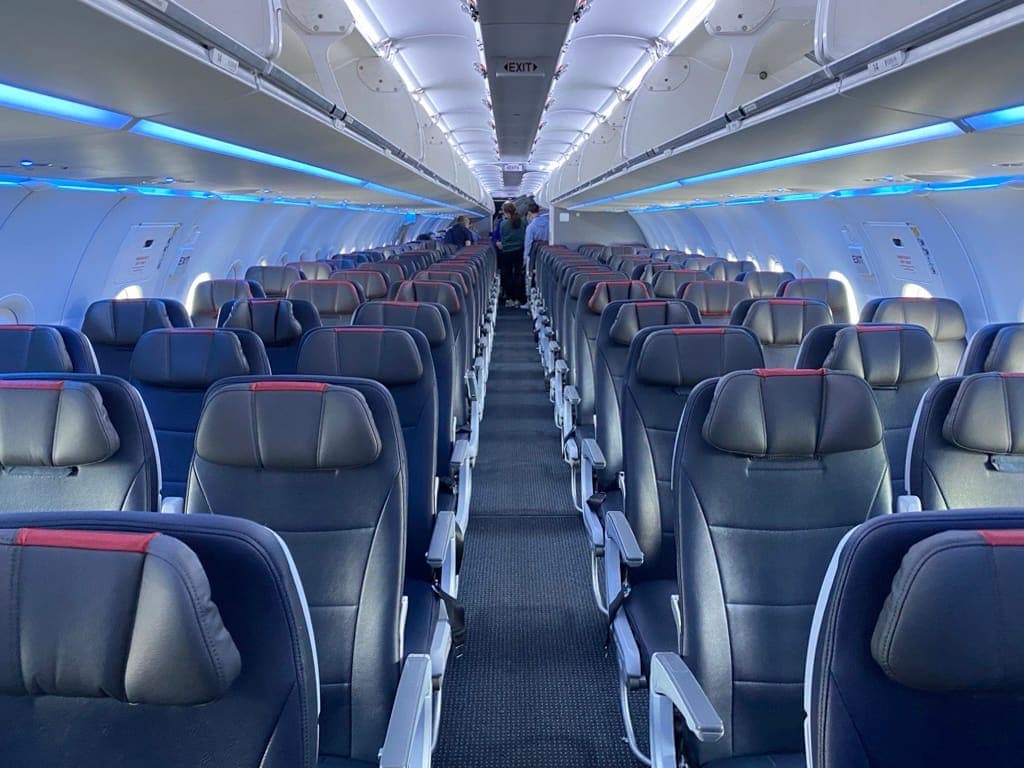 Standard economy cabin aboard an American Airlines A321neo. Public domain, Wikimedia Commons.
Economy gets you seat selection, fare rules disclosed up front, and (through Voldeluxe) a free 24-hour hold on new bookings — priced across 600 airlines rather than a single carrier's own site.
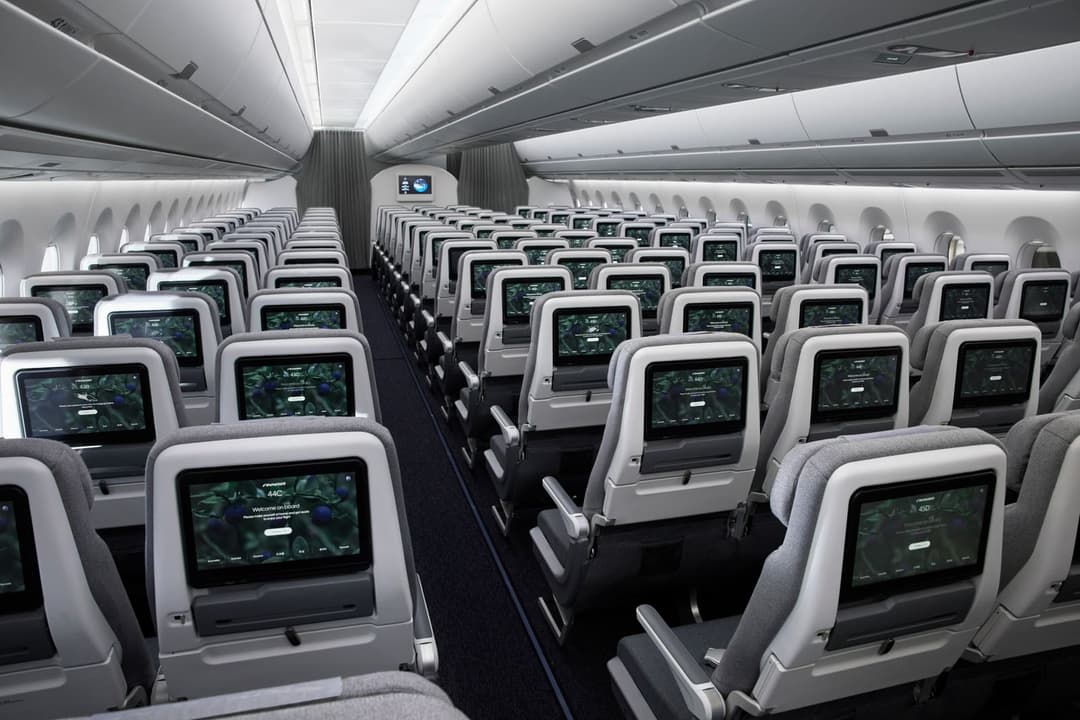 Premium economy seating aboard a Finnair A350. Photo: FinnairCommunications, Wikimedia Commons (CC BY-SA 4.0).
Premium economy trades a modest fare increase for a genuinely wider seat, extra recline, and typically two checked bags on most carriers — the sweet spot for families or anyone who wants to actually sleep on a long leg without paying for business.
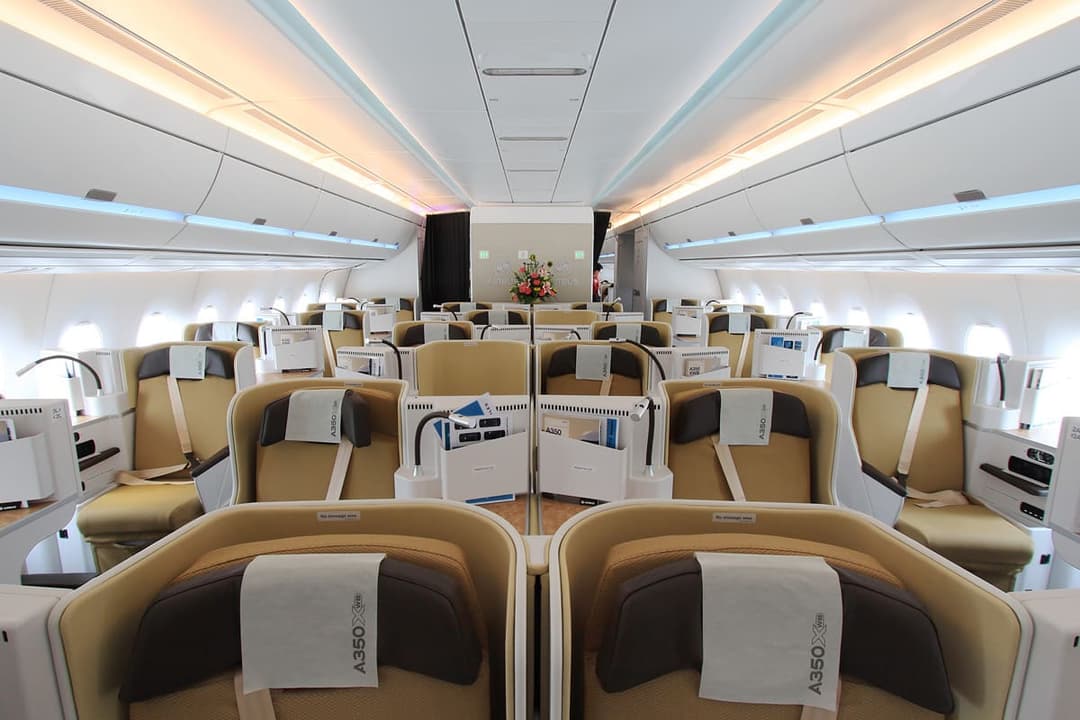 A350 business class in a 1-2-1 configuration, giving most seats direct aisle access. Wikimedia Commons (GNU FDL 1.2).
Business gets you a lie-flat seat, lounge access on most international routes, fast-track security where it's offered, and — through an agency booking — a named agent for the whole trip rather than a call center. See our current cabin offers for what's included at each tier on the routes we book most.
Read our family long-haul flying guide for how cabin choice changes when kids are in the mix.
Documentation You Need Before You Search
Every U.S. traveler needs a passport valid for international travel, and increasingly, that's not a given: 183.2 million Americans held one at the end of FY2025, up from 169.9 million the year before, meaning tens of millions of first-time or renewing applicants are moving through the system right now (U.S. Department of State, FY2025). Build in real lead time — passport and visa processing don't move at internet speed, and neither does an embassy's visa queue during peak season.
Beyond the passport, check your destination's specific entry requirements (visa, e-visa, or visa-on-arrival), any vaccination documentation some countries still require, and — if you're traveling with a minor as a solo parent or grandparent — the destination country's rules on parental consent letters. We cover that last point in detail, since it trips up more families than almost anything else, in our guide to flying internationally with kids.
What Changes When You're Booking for Families
Family bookings need seats held in one row or adjoining rows, and airline seat-assignment algorithms don't do that automatically. Ask specifically for family seating at the time of booking, not after — Voldeluxe's family mode filters out fares where adjacent seats can't be pre-assigned, and if an airline moves your group at the gate anyway, we refund the seat fees and rebook the row on the return leg. Under-2s fly free on many of the fares we track, and checked car seats and strollers are included on every partner airline.
For the full rundown on passport rules for minors, lap-infant fares, TSA screening for kids, and the current status of federal family-seating rules, see our dedicated guide: flying internationally with kids from the USA.
What Changes When You're Booking as a Student
Student fares typically include extra baggage and a fee-protected open return, which matters when you don't have a fixed return date yet — a semester abroad, a gap year, or a program with a flexible end date all benefit from a ticket that doesn't penalize you for changing the return leg. Voldeluxe prices student fares with extra baggage and free date changes to 190 university cities. If you're booking with an F-1 visa in hand, keep your I-20 and visa documentation with your travel documents, not buried in checked luggage — some check-in counters ask to see it before issuing a boarding pass on the outbound leg.
What Changes When You're Booking a Group
Group bookings of 12 or more travelers run on a manifest, not individual reservations, and that changes the mechanics: fares are typically held on a deposit while names are collected, rather than priced and locked traveler-by-traveler while the fare climbs. Voldeluxe holds group fares from 12 to 400 travelers, with name changes accepted up to 14 days before departure — useful for school trips, sports teams, and wedding parties where the final headcount isn't locked until close to departure. See our group travel desk for how deposit-held fares work in practice.
What Changes When You're Booking Corporate Travel
Corporate travel adds policy controls, consolidated invoicing, and duty-of-care reporting — none of which a self-serve booking tool handles well when a trip changes at the last minute. Managed travel through an agency means one invoice ready for expense reporting, a policy engine that keeps bookings inside your travel policy automatically, and a real point of contact if a traveler's flight is disrupted mid-trip. Our corporate travel desk covers setup for new accounts.
What Changes When You're Booking Pilgrimage Travel
Hajj, Umrah, Char Dham, and Vatican departures carry their own visa handling, group escort, and on-ground coordination needs that a standard fare search doesn't touch. These trips are typically block-booked well ahead of peak religious calendar dates, with visa processing timelines that need to be built into the booking window from day one, not treated as an afterthought once flights are ticketed.
Common Mistakes to Avoid
- Booking the first fare a search engine surfaces without checking whether a consolidator or direct-contract fare beats it on the same route and dates.
- Ignoring the 2026 fuel-market context. A route that was cheap and stable in 2024 may be running a very different fare pattern in 2026 depending on which corridor it crosses (Oxford Economics, Apr 2026).
- Leaving passport renewal to the last month. With passport volumes at record highs, processing queues are under real pressure (US State Dept, FY2025).
- Assuming a family, group, or corporate booking works the same as a single-traveler fare. Each has different rules on baggage, manifests, and refunds that a generic booking flow won't surface.
- Booking through an unaccredited reseller for a consolidator fare, leaving you with no direct recourse if the ticket needs a waiver or refund.
Frequently Asked Questions
How far in advance should I book an international flight from the USA?
Most international routes price lowest around seven to eight weeks before departure, though this varies by region — flight-search data puts Europe and Mexico/Caribbean fares at their lowest around 48–50 days out (2025–2026 flight-search data). Longer-haul regions like Asia, Africa, and the Middle East typically need a longer window; see our best-time-to-book guide for the regional breakdown.
Is it cheaper to book directly with an airline or through a travel agency?
It depends on the route. Airlines' own published fares are the baseline, but licensed agencies can also access unpublished consolidator fares that sometimes beat the published price, especially on long-haul international and premium-cabin tickets (travel-industry trade coverage, 2025–2026). Comparing both side by side, rather than assuming one is always cheaper, is the reliable approach.
What's the difference between premium economy and business class on a long-haul flight?
Premium economy offers a wider seat, more recline, and extra baggage on most carriers, at a fraction of the business-class fare. Business class adds a lie-flat seat, lounge access on most international routes, and typically a refundable fare option. On flights over 10 hours, the difference is felt in how rested you are on arrival, not just comfort in the air.
Do I need a visa for international travel from the USA?
It depends entirely on your destination and passport. Many countries allow visa-free or visa-on-arrival entry for US passport holders, while others require an e-visa or an embassy-issued visa arranged in advance. Check your specific destination's current requirements well before booking, since visa processing timelines vary widely by country and season.
How does group travel booking work differently from an individual flight?
Group bookings (typically 12+ travelers) are usually held on a per-seat deposit while final names are collected, then ticketed together on one manifest, with name changes accepted up to a set cutoff (often 14 days before departure). This protects the group from rising fares while headcounts are still being finalized, which an individual booking flow doesn't offer.
What should families know before booking an international flight with kids?
Seating together isn't automatic — request family seating specifically at booking, check passport validity rules for minors (which differ from adult passports), and confirm lap-infant fare rules if traveling with a child under two. Our family long-haul flying guide covers passport, TSA, and fare specifics in depth.
Continue Learning
Plan the timing:
Choosing who to book with:
Traveling with family:
Start a booking:
- Search flights across 600 airlines
- Group travel, 12 to 400 travelers
- Corporate managed travel
- Questions travelers ask
About the author: Srikanth Borra is a Senior International Travel Consultant at Voldeluxe with nine years of experience booking long-haul itineraries across 600+ airline partners for families, students, corporate accounts, and pilgrimage groups departing the USA, with particular focus on fare-class strategy and multi-passenger group bookings.
Published September 13, 2026. Voldeluxe is an ARC-accredited US travel agency; fares referenced are illustrative and change with the fare market. This guide reflects fare-market and policy data verified as of its publish date — always confirm current pricing and entry requirements before booking.
Ready to price your trip?
Tell an expert your dates and party size. We compare consolidator and published fares across 600 airlines and confirm same day.
Search flights and stays